
INSIGHT
How to Mentally Prepare for a Climbing Competition.
What mindset training really looks like across a season, how to build routines that hold up under pressure, and why the same mental preparation used by Olympic climbers can support competitors at every level.

QUICK TAKEAWAY
Mental preparation for competition is a trainable skill, not a personality trait.
Competition climbers at every level, from first regional events to the Olympics, rely on the same foundational tools. The aim is not to eliminate nerves, but to build routines, attention skills, and information gathering that let you compete from a calmer, clearer, more prepared place. That work is often invisible from the outside. It is most of what separates climbing well in training from climbing well on the day.
➤ Nerves before a competition are normal. The goal is a better relationship with them, not their absence.
➤ Consistent pre-competition and between-attempt routines are one of the most reliable ways to stabilise performance.
➤ Visualisation, breathing, and mindfulness are specific tools with specific uses, not vague ideas.
➤ At Olympic level, preparation also means gathering detailed information about the host city, venue, schedule, and isolation conditions.
➤ The journey usually takes a season or more, not a weekend.
Most competition climbers know the feeling. Weeks of good training behind you. A competition on the calendar. Then, as the date gets closer, something shifts. Sleep becomes lighter. The stomach tightens. Thoughts start circling on results, selection, who else is there, and whether you will actually climb like you do in the gym. By the time you step into isolation, the body is already on high alert.
None of that is a sign that you are not cut out for competition. It is a normal response to a high-stakes environment. The question is not how to stop feeling it. The question is how to prepare for it so it stops deciding how you climb.
This is where mental preparation becomes practical. At its best, it is not vague, motivational, or abstract. It is a set of specific tools built into your training year. Some are simple routines that take two minutes. Others are longer practices that evolve across a season. The same toolkit is used by recreational competitors, youth team climbers, World Cup athletes, and Olympians. Only the level of detail changes.
SUPPORT FOR ELITE AND ASPIRING CLIMBERS
If nerves, pressure, or inconsistency on comp day are getting in the way of your climbing, you do not have to figure it out alone.
Request a free 30-minute intro call to talk through where you are in your competition journey, what has been feeling difficult, and the kind of mental support that could make the biggest difference. No pressure and no obligation.
The emotional reality of competition climbing.
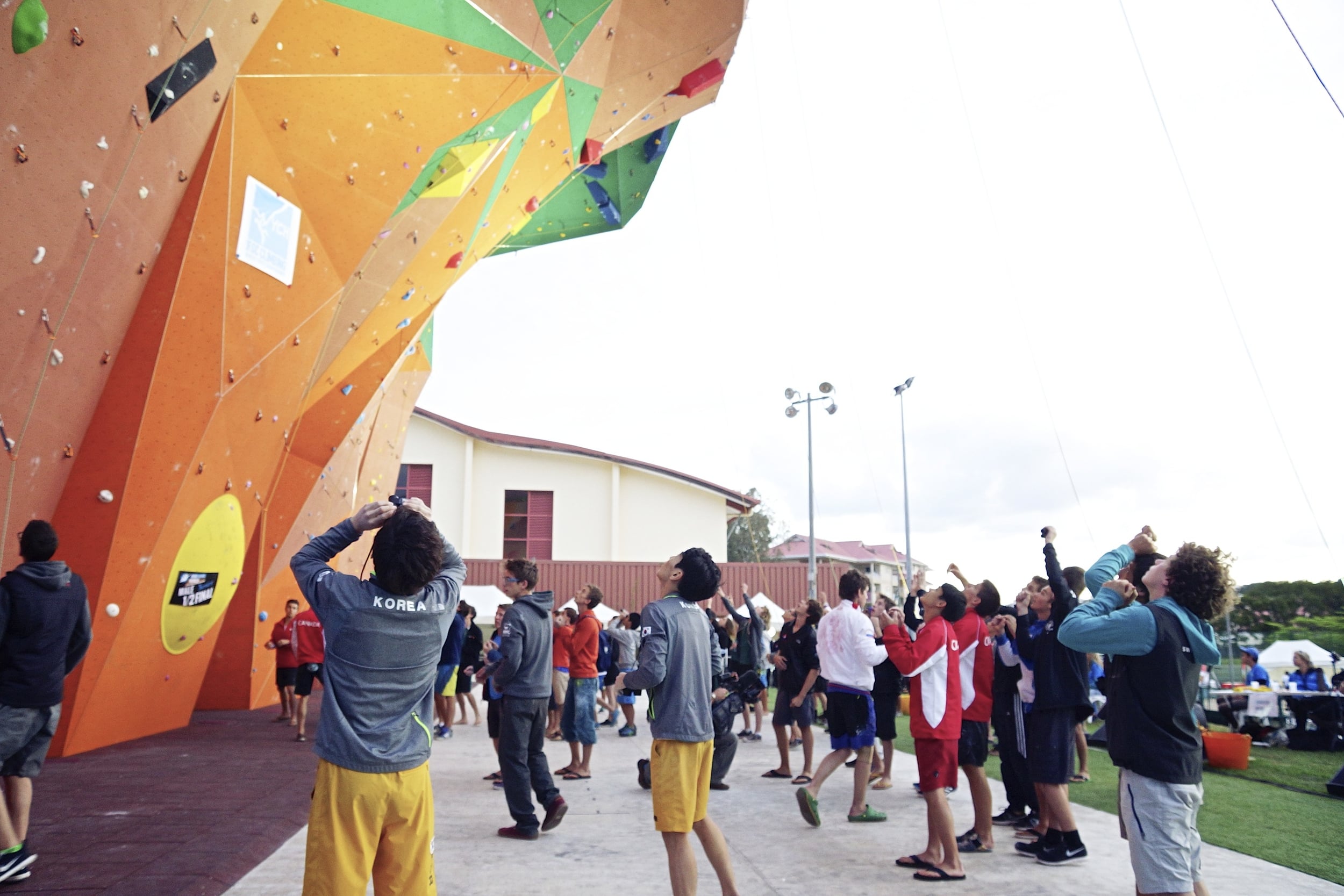
Before tools, it helps to name what you are actually preparing for. Competition climbing is rarely a clean emotional experience. It is a layered one. The isolation zone often feels quiet on the surface, but is also full of tension: other climbers stretching, music in headphones, conversations that suddenly stop, route setters walking past. When your category is called, the noise of the venue replaces that silence almost instantly. A crowd, lights, cameras, a commentator, and four minutes to solve a boulder problem or move up a route.
Inside that environment, it is completely normal to notice a racing heart, shallow breathing, cold or hot hands, a tight chest, or a mind that keeps jumping ahead to results. Many competition climbers also report difficulty sleeping the night before, appetite changes on the morning of, and intrusive thoughts about judgement, selection, or rankings.
If any of this sounds familiar, you are not unusually fragile. You are experiencing your nervous system doing what it is built to do when something important is about to happen. Mental preparation works with that system rather than against it.
IMPORTANT REFRAME
Competition nerves are not the problem. An uncontained response to them is. The goal of mental preparation is not to become emotionally flat, but to build enough structure around those sensations that they stop hijacking your attention, your routines, and your climbing.
A competition is not one performance. It is a series of small performances held together by your ability to recover between them.
What mindset training actually looks like.
People sometimes imagine mental training as one big reveal: a single conversation that fixes nerves, or a visualisation exercise that makes pressure disappear. In practice, it looks much more like building a layered routine that is practised regularly and gets refined over a season.
For most competition climbers, the core components are similar. What varies is how each climber blends them.
1. A pre-competition routine.
A pre-competition routine is a sequence of actions and mental cues you use in the hours and minutes before you climb. It does not have to be complicated. It has to be repeatable under stress.
Typical ingredients include sleep and food plans for the day before and the day of, a warm-up protocol you know you can execute even when nervous, a breathing or grounding practice, one or two cue words or intentions for the day, and simple decisions already made in advance about what you will listen to, eat, and drink.
The point is not rigidity. It is cognitive offloading. Every decision you make in advance is a decision you do not have to make with adrenaline in your system.
2. Visualisation that is specific, not generic.
Visualisation (or mental imagery) is one of the most studied tools in sport psychology and one of the most misused. Used well, it rehearses movement, decision-making, and emotional regulation. Used badly, it is a daydream.
Effective visualisation for climbing tends to be short, sensory, and specific. You picture moves in real time rather than in fast-forward. You include breathing, rhythm, and body sensations rather than just the outcome. You also rehearse how you respond when things do not go to plan: missing a hold, pumping out, facing an unexpected beta, or watching a rival send cleanly before you climb.
Olympic-level athletes often rehearse their key sequences and their emotional responses many more times than they physically climb them. This is not magical thinking. It is deliberate practice for the mind.
3. Mindfulness and mental resets between attempts.
Comp rounds, especially bouldering, are rarely decided by the first attempt. They are often decided by what happens between attempts. A climber who can reset, breathe, and return to the next problem with clarity has a major advantage over one who is still replaying the last one.
Mental resets tend to combine three things: a brief physical reset (light movement, stretching, water), a breathing pattern that downshifts the nervous system, and a cue that re-anchors attention in the present problem. Something as simple as three slow exhales, a glance at a specific hold, and one clear intention can be enough.
Mindfulness here is not sitting cross-legged in the isolation zone. It is the practised ability to bring attention back to what is in front of you when the mind wants to replay or predict.
4. Energy and attention management across a round.
One of the most underestimated elements of competition preparation is energy management. A lead round can last well over an hour. A bouldering round with multiple problems, transitions, and observation periods asks for focus in waves, not in one continuous stretch.
Competition climbers often benefit from planning where they will switch up (focus, commitment, execution) and where they will switch down (rest, recover, observe). Trying to hold maximal focus across an entire event usually leads to exhaustion by the final attempt. Learning to move between intensity and recovery is part of the skill.
5. Self-talk that is honest, not loud.
What you say to yourself before, during, and after a climb matters. Not because affirmations are magic, but because your self-talk is essentially your internal coaching voice in real time. If that voice is harsh, vague, or panicked, it shapes your climbing accordingly.
Useful competition self-talk tends to be short, specific, and kind. It names what to do rather than what not to do. It points at process rather than outcome. It sounds more like “breathe, trust your feet, commit to the crux” than “do not blow this.”

MORE FREE EDUCATION
Not ready for a call?
Follow Climbing Psychology on Instagram for practical sport psychology education on competition nerves, pre-comp routines, visualisation, focus, and the mental side of comp climbing.
What the coaching journey actually looks like across a season.
One reason mental preparation gets misunderstood is that its most important effects show up over months, not minutes. A single session can give a climber a useful tool. A season of structured mental work can change their relationship with competition entirely.
A typical competition climber’s journey with a sport psychologist tends to move through a few phases:
Early sessions: understanding your pattern. What actually happens in your body and mind before, during, and after competitions? When do nerves first arrive? What thoughts tend to repeat? What has helped in the past? This phase is mostly about noticing, not fixing.
Mid-season: building tools. This is where routines, visualisation, breathing, self-talk, and mental resets get drafted, tested, and refined. Most climbers experiment with several versions before something clicks.
Peak comps: applying under real pressure. Tools now get stress-tested in real events. Some will work straight away. Some will need tweaking. Some will collapse under pressure, which is exactly the information needed to rebuild them.
End of season: integration and review. What held up? What did not? What has changed in how you experience competition? What do you want to carry into next year?
By the end of a season of this kind of work, many competition climbers describe a meaningful shift. The nerves have not disappeared. The stakes have not become smaller. What has changed is that the internal response to those stakes is less overwhelming, and the tools they reach for are more automatic.
A USEFUL EXPECTATION TO SET
Mental training is not a quick fix. Like physical training, it compounds. The climbers who benefit most are usually the ones who treat it as a year-round practice rather than an emergency measure in the week before a major event.
Preparing for competition at Olympic level.
At the top of the sport, mental preparation becomes more detailed, but the underlying principles stay the same. Sport psychologists working with Olympic climbers often spend significant time on one particular task: reducing the unknown. Unfamiliarity is one of the biggest amplifiers of stress, and Olympic Games are full of new variables.
A well-prepared Olympic athlete is usually working with their coaching team to gather information about:
➤ The host city: time zone, climate, altitude, culture, language, and anything that affects acclimatisation and daily life.
➤ The Olympic village: living conditions, who will and will not have access, food, sleep environment, and travel time to training and venue.
➤ The competition venue: size, lighting, wall conditions, crowd layout, media presence, and anything the athlete can realistically simulate in advance.
➤ The competition itself: training and competition schedules, format, qualification and finals structure, route setters, fellow competitors, and the isolation protocol.
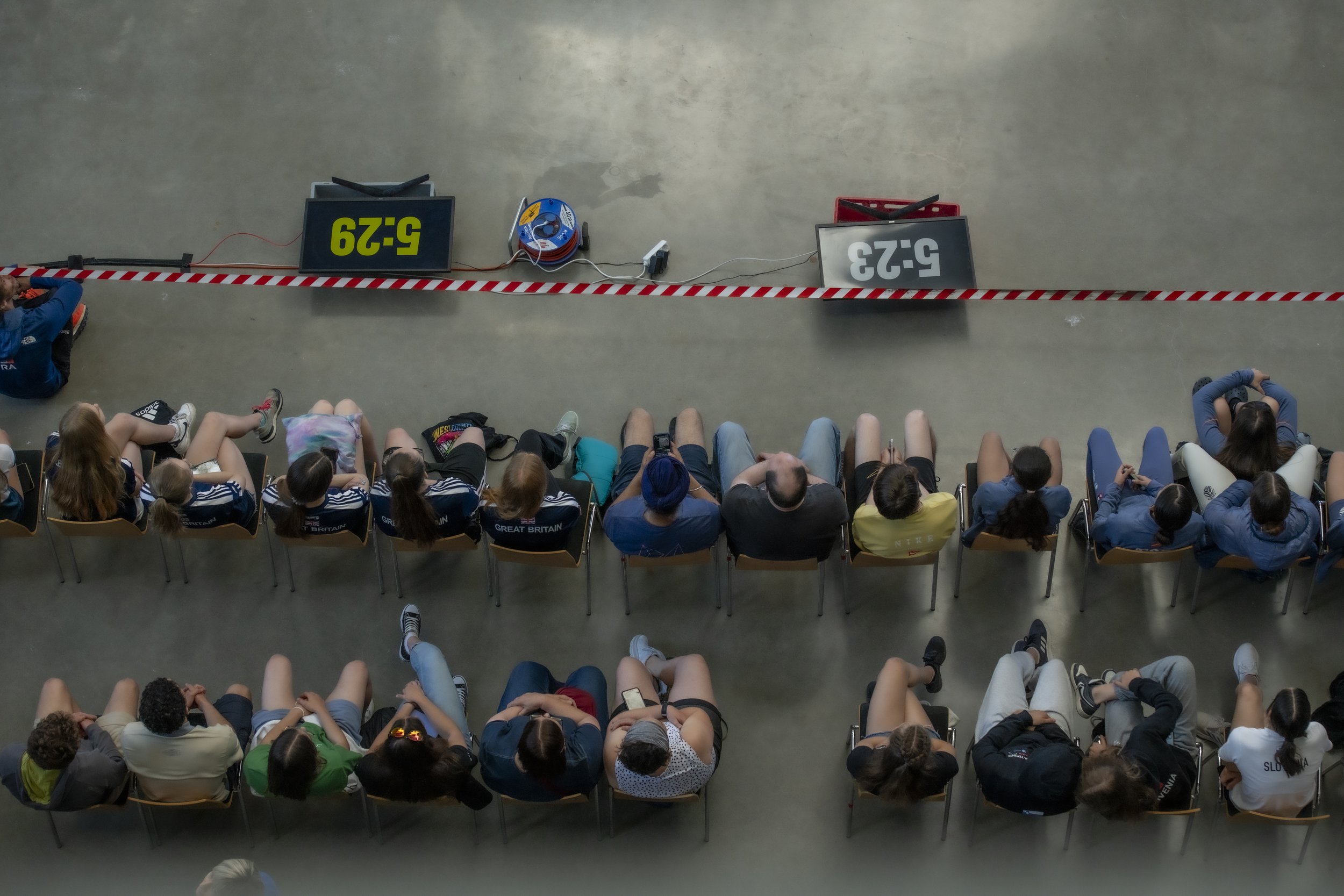
On top of that, the sport psychologist will often help the athlete build a very specific plan for the isolation zone, which is one of the most psychologically demanding parts of an Olympic competition. How will they warm up? What will they listen to? When will they eat? How will they manage waiting, observation, and the emotional impact of watching other athletes? What are the cues that bring them back to themselves?
The aim is not to control everything. Olympic environments are unpredictable by nature. The aim is to narrow the unknown to a manageable size so that the athlete can focus their mental energy on climbing well, rather than on basic logistics and surprises.
Elite preparation is not about feeling invincible. It is about making sure as few things as possible on the day are a genuine surprise.
What this means if you are not an Olympian (yet).
Most competition climbers will never go to the Olympics, and that does not make this guide any less relevant. The principles used at the top of the sport scale down very well. In fact, they are often easier to implement at regional, national, or open-level competitions, because there are fewer moving parts.
The same information-gathering approach used for Olympic prep can be applied to any competition:
➤ When and where is the event, and what is the travel plan?
➤ What is the format, timing, and category structure?
➤ What does the venue look like, and can you see photos or videos of previous events there?
➤ What are the warm-up conditions likely to be?
➤ What is your plan for food, sleep, and hydration the day before?
➤ What is your plan for the isolation or waiting period?
➤ What is one simple intention you want to bring to this competition, regardless of outcome?
None of this is glamorous. All of it reduces unknowns and conserves mental energy for the climbing itself.
Common mistakes in competition preparation.
A few patterns show up repeatedly in climbers who feel their competition performance does not match their training. They are worth naming, because recognising them is often the first step to changing them.
➤ Treating mental preparation as optional. Many climbers train physically year-round and only think about the mental side in the days before a comp. The result is inconsistent performance and a sense of randomness on the day.
➤ Copying someone else’s routine wholesale. A routine that works for a pro athlete may not fit your life, schedule, or nervous system. Routines work best when they are drafted for yourspecific situation and tested.
➤ Confusing suppression with regulation. Trying to not feel nervous, not think about results, or not notice other competitors rarely works. Acknowledging and working with those experiences is almost always more effective.
➤ Expecting breakthroughs overnight. Mental training follows the same curve as physical training. Consistency over time, not intensity in a crisis, is what produces lasting change.
➤ Ignoring recovery. Sleep, food, rest days, and downtime are part of mental preparation, not separate from it. An exhausted nervous system cannot execute a calm routine.
A USEFUL REFRAME
Mental preparation is physical preparation for your attention. You are not just training the mind in the abstract. You are building nervous system habits that hold up when the adrenaline arrives.
Bottom line.
Competition climbing asks for a lot: physical fitness, technical skill, tactical awareness, and the ability to access all of it under pressure, in front of other people, with a time limit. The mental side is not an add-on. It is the glue that lets everything else actually show up on the day.
The good news is that mental preparation is a skill, not a trait. It can be learned, practised, and refined. It looks similar whether you are preparing for your first regional comp or the Olympics. What changes is the level of detail, not the underlying work.
If you treat the mental side of competition with the same seriousness and patience you already give to physical training, competitions tend to stop feeling like a test of whether you can hold it together, and start feeling like a place where your preparation gets to speak for itself.
YOUR NEXT STEP
Want to build your own mental preparation across your competition season?
We work with competition climbers at every level, from first-year competitors to World Cup and Olympic athletes, on routines, pressure, nerves, focus, and confidence. Book a free 20-minute intro call to explore where you are and what kind of support could help most.