
INSIGHT
Your Presence at the
Comp is Part of Your Child’s Performance
How your own emotional state, role clarity, and self-awareness can shape the competitive environment your child experiences, even when you say nothing at all.

QUICK TAKEAWAY:
What you bring to a competition day emotionally,
physically, and energetically, is likely affecting your child more than you realise.
➤ Children often co-regulate with the adults around them: your calm can become their calm, and your anxiety may become theirs.
➤ Projecting how you think your child feels, rather than reading what they're actually showing you, is one of the most common and unintentional mistakes sport parents make.
➤ As your child develops, your role is likely to shift and navigating that shift clearly can reduce pressure for everyone involved.
➤ Supportive parenting in sport often looks quieter than expected.
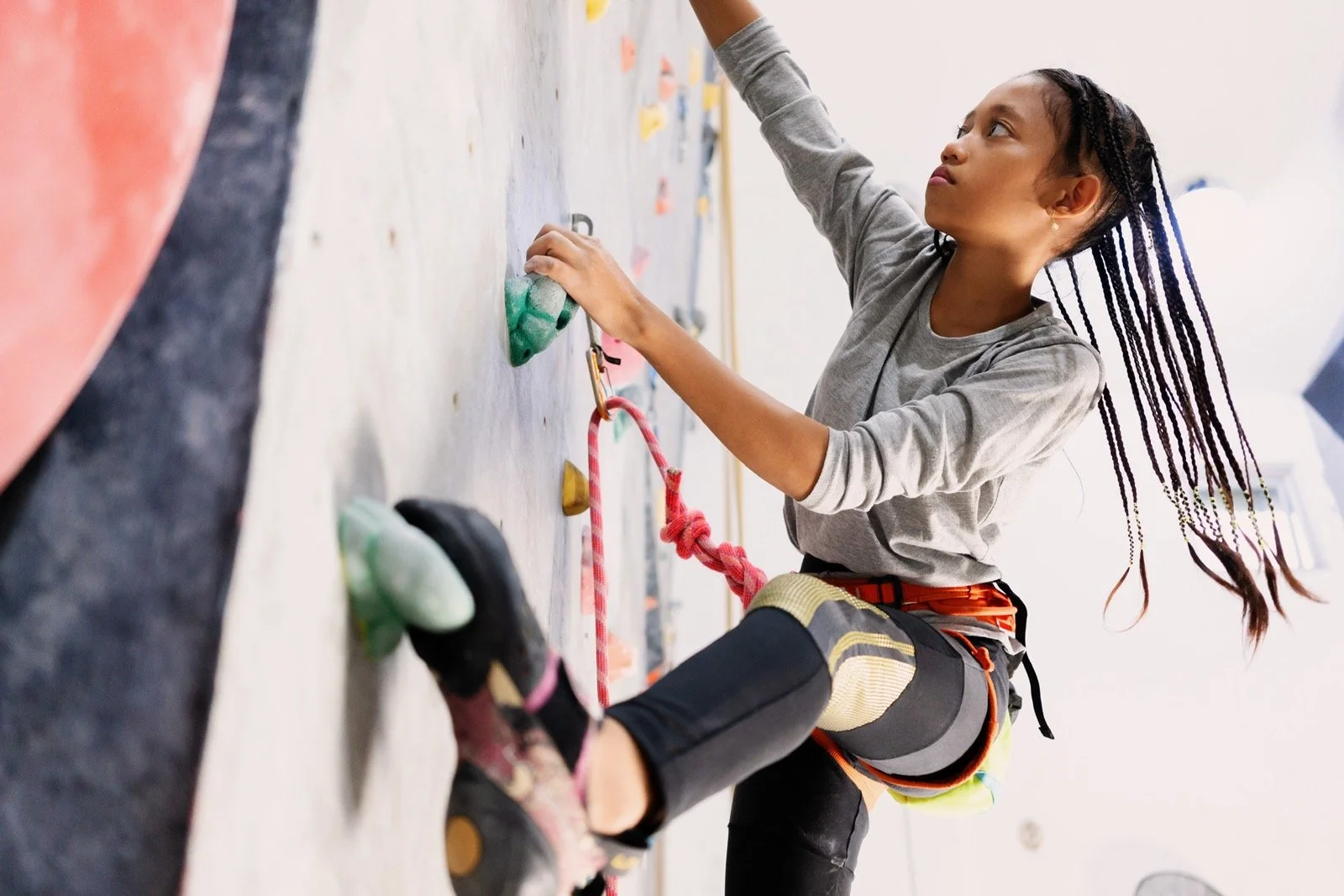
You've driven an hour to get here. You've organised kit, packed snacks, coordinated logistics, and spent the week trying to figure out how to support without hovering, encourage without pressuring, care without projecting. And now your child is on the wall and every muscle in your body is quietly bracing.
What you might not realise in that moment is that your child may be feeling it too.
Not because you've said anything. Not because you've done anything wrong. But because the people we love most tend to be deeply attuned to us and young athletes are often acutely sensitive to the emotional atmosphere around them, particularly when it comes from the people who matter to them most.
This is one of the less talked-about dimensions of being a sport parent. And it may be one of the most important.
SUPPORT FOR CLIMBING PARENTS
If you're unsure how to support your child through the mental side of climbing, you're not alone.
Request a free 20-minute intro call to talk through what feels stressful, how it is affecting you and your child, and what kind of support could help most. No pressure and no obligation.
Why your emotional state matters more than you might think.
Sport psychology has long described something called co-regulation: the way that children, particularly in high-stakes situations, orient toward the emotional state of trusted adults around them as a way of calibrating their own. In simple terms: your calm can become their calm. And your anxiety, without a word being spoken, can become theirs.
This doesn't mean you need to perform contentment you don't feel. Children are often surprisingly good at sensing when an emotional display isn't genuine, and a forced cheerfulness can sometimes create its own kind of confusion. What it does mean is that the work of managing your own internal state (before, during, and after competition) may be some of the most useful sport parenting you can do.
It can also be some of the hardest. Because competition stress in parents is real and legitimate. You've invested time, energy, money, and enormous amounts of yourself in supporting your child's climbing. Of course you feel things when the results come in. Of course you feel things on the drive there. None of that makes you a bad sport parent. It makes you human.
The question isn't whether you feel those things. It's whether you have a way of noticing them, working with them, and making sure they don't land in ways that add to your child's load.
AN IMPORTANT REMINDER:
You don't need to get every reaction right. What tends to matter most is not any single moment, but the overall pattern: whether your child feels, across time, that your warmth and support are stable things, not things that change with results.
Reading your child's actual cues and not the ones you expect.
One of the easier mistakes to make after a competition, especially an emotionally charged one, is assuming you already know how your child feels. Your child finishes fourth after expecting a podium. You immediately expect upset. So you respond to that expectation, rather than to what's actually in front of you.
But what if they're not upset? What if they climbed their best round ever and are quietly proud of it, even without the result they hoped for? What if the disappointment isn't about the ranking at all, but about something that happened with a teammate, or a coach's comment, or something entirely unrelated to performance?
When you respond to what you expect rather than what you're seeing, there's a risk of inadvertently confirming an emotion that wasn't really there or of missing the actual thing that needs attention.
A steadier approach is usually to pause before responding. Watch. Listen. Give them a moment to show you what they're actually feeling before you offer interpretation or support. And then ask, rather than tell:
"How are you feeling about today?"
"What mattered most to you about that round?"
"Do you want to talk about it now, or later?"
These aren't passive responses. They're an invitation for your child to locate their own experience, and to bring it to you on their terms. That kind of space, where they're not having to manage your reaction while also managing their own feelings, can sometimes be the most valuable thing you offer.
More free education
Want more support with parent pressure, communication, and competition stress?
Follow Climbing Psychology on Instagram for practical sport psychology education for climbing parents, coaches, and young athletes.
Understanding how your role may shift as your child develops.
In the early years of your child's climbing, the boundaries are fairly clear. You provide logistics, encouragement, equipment, and a warm car ride home. The coach runs the training. You cheer at the competitions. It's a straightforward division of roles, and it tends to work well.
But as your child develops, especially if they start competing seriously, that simplicity can start to blur.
You may have spent years watching your child train. You understand their climbing better than almost anyone. You see patterns the coach might miss. You have opinions about their preparation, their route choices, their beta, their training schedule. And all of that can make it genuinely difficult to know where coaching ends and parenting begins.
Sport psychologists who work with families in this space often observe that the overlap between these roles, well-intentioned as it usually is, can sometimes increase a young athlete's pressure rather than reduce it. Not because the parent's input is wrong, but because receiving different signals from different trusted adults tends to create a kind of internal tension that's hard to resolve. Your child may find themselves trying to satisfy two sets of expectations at once, neither fully owning their own choices.
This isn't inevitable. But it tends to be worth thinking about honestly: Whose goals are on the wall right now? Whose vision of success is your child climbing toward?
Self-Determination Theory, one of the more robust frameworks in motivation research, suggests that athletes tend to perform better and sustain their motivation longer when they feel genuine ownership over their choices and goals. Every time the direction comes from outside, that sense of ownership can weaken a little. Every time a child is asked "What do you want to get out of this competition?" rather than being told what to focus on, it strengthens it.
A STEADYING THOUGHT: Supportive parenting in sport often looks quieter than people expect. It can look like sitting with your child in comfortable silence after a hard day. Like not making the atmosphere at home depend on how a comp went. Like letting a disappointing result be disappointing without rushing to resolve it. These are not passive things. They take real skill.
What being a steady presence can look like.
Being emotionally present for your child at competitions doesn't require a particular set of words or a specific sequence of actions. It tends to look more like a general orientation: toward them, toward curiosity, toward stability.
Some of what it might include:
➤ Checking in with your own state before you check in with theirs.
➤ Resisting the urge to analyse the result on the drive home (unless they want to).
➤ Asking what they need rather than assuming.
➤ Making sure warmth and connection aren't visibly performance-dependent.
➤ Being willing to sit with their disappointment without trying to fix it immediately.
None of these are things you'll do perfectly every time. That's not the goal. The goal is a general direction, a pattern your child can feel over time, that tells them: whatever happens on that wall, this is a safe place to land.
Final thoughts for climbing parents.
The parenting that shapes a young athlete most isn't usually the big speech before the finals or the perfectly chosen words in the moment of crisis. It tends to be the accumulated texture of hundreds of ordinary moments: how you are in the car, what you notice after a training session, whether you ask or assume, whether your presence feels like support or like pressure.
You can't control how a route gets set, how a judge sees a movement, or how your child's body performs on any given day. What you can shape, over time, is the emotional environment around all of it.

YOUR NEXT STEP
Want support as a climbing parent?
We support climbing parents who want to better understand the mental side of their child's sport. Book a free 20min intro call to explore what kind of support might be most useful for you and your child.